Measuring for Draperies: Why the Room Matters More Than the Tape
The numbers that decide how draperies hang are rarely the ones you get from a quick measure of the glass.
October 16, 2026 · 4 min read
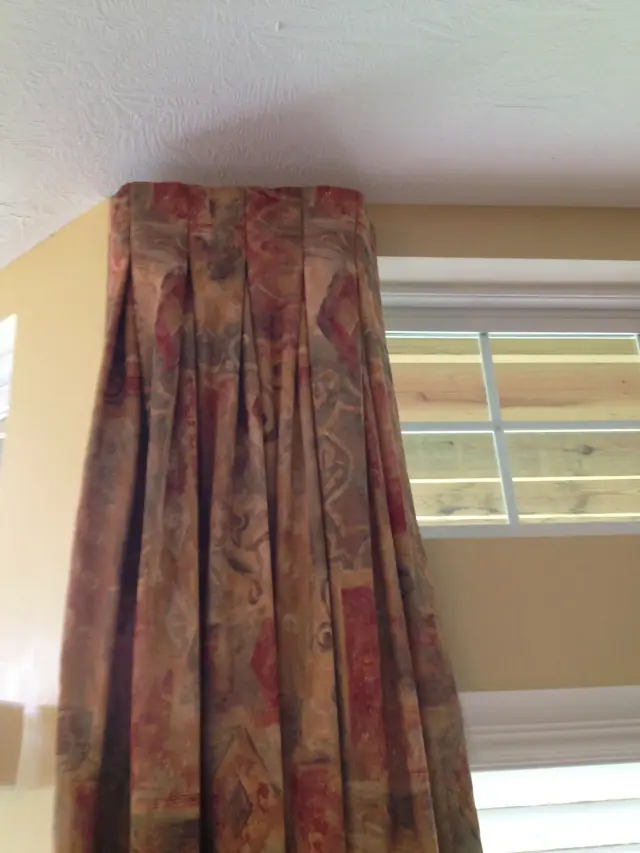
Most people reach for a tape measure the moment they decide on new draperies. It's a natural first step, and a rough width and height are good to have on hand. But the numbers that decide how your draperies hang, and how much fabric the workroom needs to cut, are rarely the ones you get from that first pass. Here's what actually goes into measuring for custom draperies, and why we think it's worth doing in the room itself.
Start with what the window has to do
Before anyone measures anything, decide what the treatment is for. Do you want to block morning sun in a bedroom, soften a bare wall of glass, add privacy on a street-facing window, or simply frame a view you like looking at? A pair that stays open all day can be gathered tighter and look fuller. A pair that has to close completely needs enough fabric to cover the whole opening once it's folded into pleats.
That's the idea of fullness. Drapery fabric is never hung flat. It's pleated or gathered so it falls in soft, even folds, and the more fullness you build in, the richer it looks. As a general rule, the finished pair should be about twice the width of the space it covers, a little more for a sheer or lightweight fabric and a little less for a heavy one. Fabric stretched nearly flat across a window looks like a bedsheet, and it never hangs the way it did in the sample.
The measurements that matter
Once the purpose is clear, the real measuring begins. These are the points worth checking in any room:
- The width of the window, plus the trim around it, plus however much wall you want the draperies to cover.
- How far the rod will extend past each side of the window, so the panels can rest on the wall and leave the glass clear when they're open.
- The distance from the ceiling to the top of the window, which tells you how high the rod can go.
- The height from the rod to where the fabric should end: the floor, just above it, or the sill.
- Anything that gets in the way, such as a radiator, a heat register, a window seat, a switch or a curtain-rod bracket from the last owner.
Notice that none of those is simply the size of the glass. Hanging a rod higher and wider than the window makes the window look taller and lets in more light when the draperies are open. Most rooms look better for it. But that decision only works if someone has looked at the ceiling, the trim, and the space on either side.
Why crooked rooms need a person, not a photo
Walls and windows are rarely perfectly square. A window can be a quarter inch wider at the top than at the bottom. Floors slope, especially in older Cincinnati houses where a hundred years of settling has done its work. A drapery hemmed to a perfectly level line can look crooked against a floor that drops an inch from one corner to the other.
That's why a careful measure takes the height at the left, the middle and the right, and why the person doing it needs to stand in the room and look. Maybe the draperies should skim the floor on the low side and still clear it on the high side. Maybe the better answer is a hem that hovers slightly above the floor, so nothing drags and nothing looks off. These are small judgment calls, and they're very hard to make from a list of numbers sent over the phone.
From measurements to yardage
Measurements are only half the job. The workroom then has to work out how much fabric to order, and that depends on a surprising number of things: the fullness you chose, the width of the fabric on the bolt (decorator fabric is often around 54 inches wide), the height of the finished drapery, the allowance for the hem and the header, and the pattern repeat. A bold print has to match from one width of fabric to the next, which means cutting extra so the pattern lines up. A solid doesn't need that, so the same window can need quite different amounts of fabric depending on what you pick.
This is why we say yardage should be calculated, not guessed. Ordering too little means a seam in the wrong place or a delay waiting on another cut from the same dye lot. Ordering too much means paying for fabric that ends up in a closet. At The Sewing Loft, fabric yardage calculations are part of the service alongside in-home measurement, so the numbers come from your actual windows.
Before you call
You don't need to have every answer ready. It helps to know which rooms you're thinking about, what you want each window to do, and if you already have a fabric in mind. Photos of the windows are welcome, though they don't replace a visit. If you're curious what the process looks like, call or text Rose Lytle at 513.324.7941, or stop by the workroom at 2105 Lawn Ave. in Norwood, by appointment or by chance.
The Sewing Loft, 513.324.7941
Call 513.324.7941More articles
Roman Shade, Cornice or Valance: What Each One Does in a Room
Three window treatments that look similar in a catalog behave very differently once they're hanging in your house.
Should You Reupholster That Chair? How to Tell a Keeper from a Money Pit
A good frame can outlast three sets of fabric, and a weak one can't be saved by any amount of it.